29. november: Day of Solidarity
29th November is the UN International Day of Solidarity with the Palestinian People. Stavanger Art Museum marks the day by raising the Palestinian flag and expressing our solidarity.
Inside the museum, you can experience two artworks that address the situation in Palestine in different ways.
Jumana Mannas - Foragers
Jumana Mannas’ film Foragers explores ongoing conflicts related to foraging and conservation in Palestine and Israel. The artichoke-like plant akkoub and the herb za’atar (thyme) naturally belong in Palestinian cuisine. There are long-standing traditions of foraging for these plants in the wild. Israeli conservation laws, introduced in 1977 and 2005, have prohibited the picking of these wild plants, leading to fines and legal actions against hundreds of Palestinians who have defied the laws out of necessity or rebellion. For Palestinians, these laws serve as a means to restrict access to their own land under the pretext of environmental protection.
The film highlights the joy, knowledge, and identity linked to these plants, illustrating how foraging becomes an act of resistance for Palestinians. While not questioning the need for environmental conservation, the film raises important questions about who decides what gets eradicated and what is allowed to thrive.
Michael Rakowitz - I'm good at love, I'm good at hate, it's in between I freeze
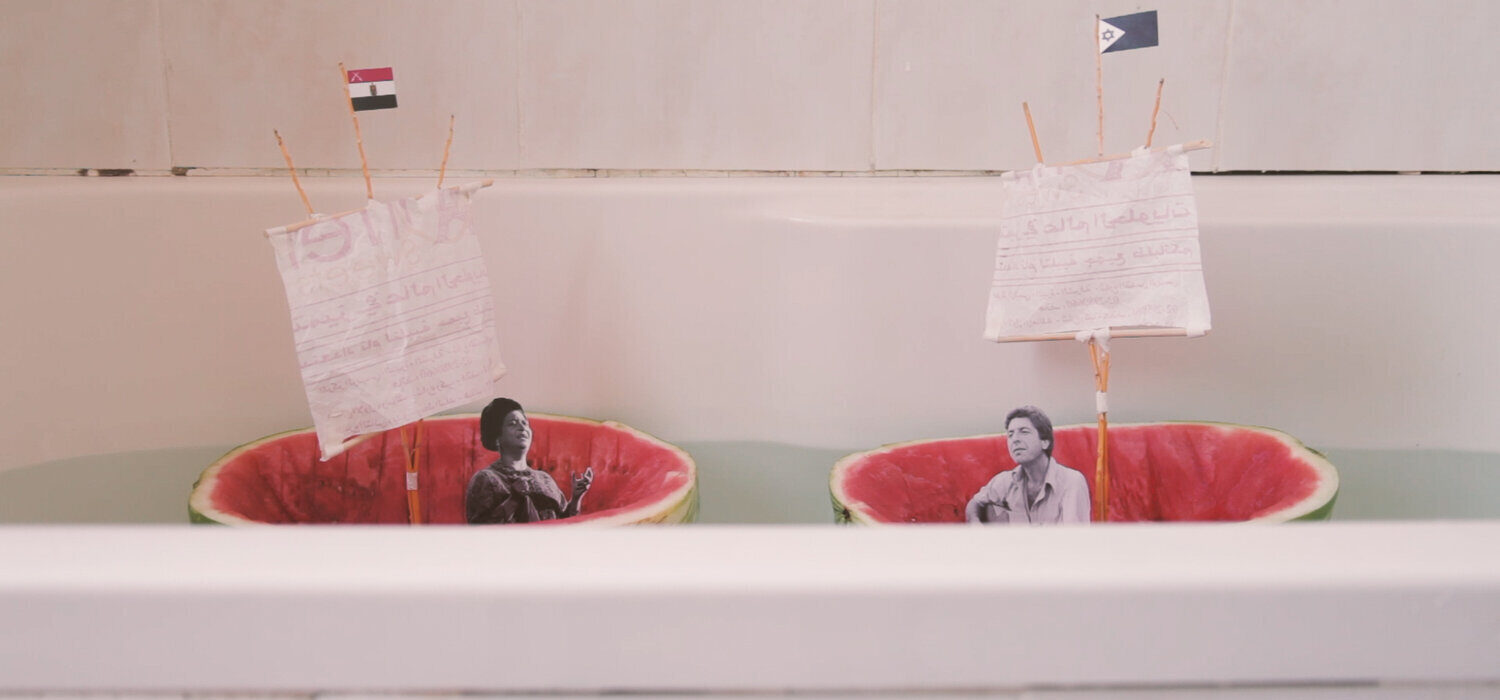
Michael Rakowitz is an Iraqi-American artist who sheds light on the Israel-Palestine situation through his interest in Leonard Cohen’s music. The artwork I’m good at love, I’m good at hate, it’s in between I freeze is a half-hour film accompanied by a collection of memorabilia, originally created for a commemorative exhibition in honour of Leonard Cohen in Montreal in 2017. In the film, we follow an actor resembling Cohen as he wanders around Ramallah. The situation references a planned Cohen concert in Ramallah in 2009, which was boycotted and subsequently cancelled.
In three display cases, we find several objects that also appear in the film. These include portraits of Rakowitz’s own Arab-Jewish family, Cohen's typewriter, a photo of Cohen performing for Israeli soldiers, and several LP records, including those by the Egyptian musician Umm Kulthum, who is popular throughout the Middle East. We also find a couple of Cohen's poetry collections translated into Persian.
When the exhibition opened in Montreal, Cohen's management reacted by revoking Rakowitz’s rights to include Cohen’s music in the film because he posed critical questions regarding Cohen and his support for Israel. Six years later, Rakowitz and his co-director Robert Chase Heisman reworked the film with new music from musician Bill McKay. Where Cohen’s music was previously audible in the film, they replaced it with the voices of friends from - and of - Palestine, who attempt to describe what we no longer hear.
Rakowitz addresses questions surrounding artistic and cultural boycotts. The film serves as a poetic portrayal of a fictional event, where the notable absence of Leonard Cohen's music makes us especially attuned to the questions Rakowitz raises.
More about UN Day of Solidarity with the Palestinian People, here.